

Autobianchi A112 wiring diagram and fault finder
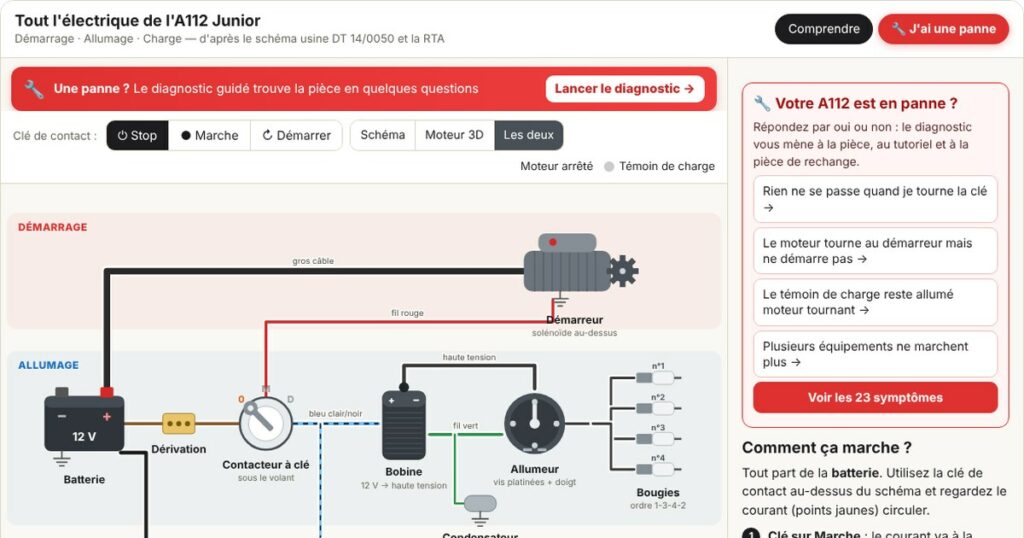
Autobianchi A112 and Fiat 127 wiring diagram and fault finder
All the electrics of the Autobianchi A112 & Fiat 127
Technical data for the electrical system
The 10 fuses (A112 from 1978, including the Junior)
Box under the steering wheel, on the left, behind a plastic cover. Layout taken from the site's fuse tutorial (in French):
| Fuse | Rating | Circuits protected |
|---|---|---|
| A | 8 A | Brake lights, reversing light, heater fan, voltmeter, oil pressure gauge and oil thermometer |
| B | 8 A | Indicators and their warning light, wipers, washer, rev counter, fuel gauge and low-fuel warning light, oil warning light, water temperature gauge, brake fluid warning light, rear wiper, choke warning light |
| C | 8 A | Left main beam and its warning light |
| D | 8 A | Right main beam |
| E | 8 A | Left dipped beam, rear fog light and its warning light |
| F | 8 A | Right dipped beam |
| G | 8 A | Front left and rear right sidelights, sidelight warning light, dashboard and instrument lighting |
| H | 8 A | Front right and rear left sidelights, number plate light, clock lighting |
| I | 16 A | Radiator fan, interior light, horn, spotlight |
| L | 16 A | Cigar lighter, heated rear window and its warning light, clock |
The RTA confirms 10 fuses from January 1978 (eight 8 A and two 16 A). The charging, ignition and starting circuits and the charge warning light have no fuse.
The 8 fuses (A112 before 1978)
Box at the right-hand end of the dashboard, under a cover marked “Autobianchi A 112”. From left to right (RTA):
| No. | Rating | Circuits protected |
|---|---|---|
| 1 | 8 A | Oil and water warning lights, fuel gauge and low-fuel warning light, indicators and their warning light, fan relay, brake lights, wipers, heater fan |
| 2 | 16 A | Interior lights, horns, fan motor |
| 3 | 8 A | Left main beam headlight, main beam warning light |
| 4 | 8 A | Right main beam headlight |
| 5 | 8 A | Left dipped beam |
| 6 | 8 A | Right dipped beam |
| 7 | 8 A | Front left and rear right sidelights, sidelight warning light, left number plate light, dashboard lighting |
| 8 | 8 A | Front right and rear left sidelights, right number plate light, engine bay light |
No fuse for the charging, ignition and starting circuits or the charge warning light. From January 1978, the RTA lists 10 fuses (eight 8 A and two 16 A): check the box on your own car. Tutorial: replacing the fuses (in French)
The bulbs (12 V)
| Use | Type | Wattage |
|---|---|---|
| Headlights main and dipped beam | Twin-filament round bulb, asymmetric dipped beam | 45/40 W |
| Rear brake / sidelights | Twin-filament round bulb | 21/5 W |
| Front and rear indicators | Round bulb | 21 W |
| Number plate light | Round bulb | 5 W |
| Engine bay light, interior lights | Festoon | 5 W |
| Front sidelights, side repeaters, boot light | Tubular | 4 W |
| Warning lights (indicators, headlights, sidelights, charge, oil, low fuel) and dashboard lighting | All-glass (capless) | 3 W |
Source: RTA, bulb table. A112 Abarth models from 1974 have H4 60/55 W halogen headlights.
Fan, wipers, indicators, warning lights
| Radiator fan thermoswitch | Switches on at 90–94 °C, off at 85–89 °C (factory manual DT 01/0210) · torque 49 N·m (factory manual) |
| Radiator fan motor | 55 W (RTA) |
| Heater fan motor | 20 W (RTA) |
| Wiper motor | 25 W, 52 to 68 sweeps per minute (RTA) |
| Flasher unit | 85 ± 8 cycles per minute with 46 W at 12 V. If an indicator bulb has blown, the warning light flashes noticeably faster (RTA) |
| Oil pressure warning light | Comes on if the pressure drops. Normal pressure with the engine hot: 3 to 4 bar; at idle, no less than 0.6 bar (RTA, Abarth oil pressure gauge) |
| Low-fuel warning light | 30 L tank, including 4 to 6 L in reserve (RTA) |
| Headlight alignment | Car 5 m from a wall: the dipped beam must fall 95 mm below the height of the headlight centres (RTA) |
Wire colour code (factory wiring diagram)
| Letter | Colour | Letters | Colour |
|---|---|---|---|
| A | Light blue | AB | Light blue with white stripe |
| B | White | AN | Light blue with black stripe |
| C | Orange | AR | Light blue with red stripe |
| G | Yellow | BN | White with black stripe |
| H | Grey | GN | Yellow with black stripe |
| L | Blue | HN | Grey with black stripe |
| M | Brown | HR | Grey with red stripe |
| N | Black | VN | Green with black stripe |
| R | Red | NZ | Black with violet stripe (used on the diagram, missing from the key) |
| S | Pink | ||
| V | Green | ||
| Z | Violet |
Source: factory manual DT 14/0050. The letters are the Italian colour initials. A number after the letters gives the cross-section in mm² (e.g. “AN 2.5”).
Electronic ignition (A112 Elite and Abarth)
These versions have no contact breaker points. Precautions from the factory manual:
- never earth the low-tension wire between the coil and the rev counter (for example for an immobiliser);
- connect the timing light directly to the battery positive;
- don't do a spark test by pulling the HT leads apart.
Autobianchi A112 Junior electrics: starting, ignition and charging
The A112 Junior (A112 B chassis, 903 cc engine) has a 12 V system with negative earth to the body. Here is what each part does, the original wire colours and the most common faults, based on factory wiring diagram DT 14/0050 and the RTA (Revue Technique Automobile, the French workshop manual).
Starting circuit
- Battery: The energy store. It turns the starter motor and powers the car while the engine is not running.
- Junction block: A small terminal block that shares the battery positive between the ignition switch and the fuse box.
- Ignition switch: The main switch: in “On” it feeds the ignition and the dashboard, in “Start” it operates the starter motor.
- Starter motor: An electric motor that turns the engine over to start it. Its solenoid (the small cylinder on top) pushes the pinion forward and closes the heavy circuit.
Ignition circuit
- Ignition coil: It turns the 12 V into a very high voltage every time the contact breaker cuts the current.
- Condenser: It stops the contact breaker points from burning and makes the spark stronger.
- Distributor (contact breaker): It makes the spark at the right moment: its cam opens the contact breaker points, then the rotor arm sends the high voltage to the right spark plug.
- Spark plugs: They make the spark in each cylinder, in the order 1-3-4-2.
Charging circuit
- Alternator: Driven by the belt, it recharges the battery and powers the car while the engine is running.
- Charge warning light: The red light on the dashboard. It comes on with the key on On and must go out as soon as the engine is running.
Common electrical faults
- Nothing happens when I turn the key: the starter gets the signal but is short of current, faulty starter motor or solenoid, ignition switch or broken red wire, no current reaching the ignition switch, flat battery or loose terminal.
- The starter clicks or turns slowly: poor contact on the heavy cables, flat or worn battery, tired starter motor.
- The starter turns but doesn't turn the engine: starter that doesn't disengage, pinion no longer engaging, damaged flywheel ring gear.
- The engine cranks but won't start: flooded engine, ignition is fine so the fault is in the fuel supply, distributor cap, rotor arm or plug leads, coil or condenser, dirty or badly adjusted contact breaker points, no ignition current.
- Misfiring, hesitation when accelerating: coil weakening when hot, mixture out of adjustment, HT leakage, contact breaker and condenser.
- The engine stalls or cuts out suddenly: poor contact in the ignition switch, coil cutting out when hot, contact breaker wire, condenser or fuel.
- Hard starting when cold: the starter is short of current, spark plugs need replacing, weak ignition.
- Won't restart when hot: coil cutting out when hot, fuel vaporising (vapour lock), engine flooded when hot, ignition or fuel fault.
- The charge warning light stays on with the engine running: D+ wire or warning light, faulty alternator or regulator, broken or slack belt.
- The charge warning light never comes on: faulty alternator, blown bulb or broken wire, no current after ignition.
- My battery keeps going flat: a circuit drains power with the car off, worn battery, the alternator isn't recharging.
- Odd faults: dim lights, erratic gauges, dashboard going dead: poor earth, fuse B making poor contact, loose wire or terminal.
- Just one light doesn't work: bulb to replace, fuse, bulb holder or earth, headlight switch (stalk), shared fuse.
- Indicators not working or flashing too fast: blown indicator bulb, fuse B or flasher unit, stalk switch (under the steering wheel).
- Headlights, wipers or washer playing up: stalk switch (under the steering wheel), fuse or contact.
- The radiator fan doesn't come on, the engine overheats: faulty thermoswitch, fuse I or fan motor, low coolant.
- The reversing light stays on or doesn't come on: reversing light switch stuck, bulb or switch, fuse A.
- The fuel gauge doesn't work: fuel tank sender or its wire, fuse B.
- The brake lights don't come on: brake pedal switch, bulb or light earth, fuse A.
- The heater fan no longer blows: switch, wire or earth, faulty fan motor, fuse A.
- The heated rear window no longer heats: relay or broken heating elements, fuse L or switch, terminal torn off.
- The oil warning light stays on with the engine running: low oil, pressure too low or oil pressure switch.
Your fault isn't in the list?
Describe what your A112 is doing: we read every message and add missing faults to the fault finder. If you come from the fault finder, your answers are attached automatically. You can write in English.
Ce tutoriel vous a aidé ?
Posez vos questions ou partagez votre retour en commentaire, nous répondons à chaque message.
Laisser un commentaireVous avez réparé votre Autobianchi A112 ?
Envoyez-nous vos photos et vos explications : nous les mettons en forme et vous recevez des cadeaux exclusifs.
Devenez contributeur